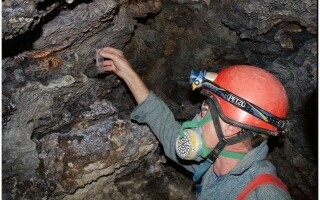
Scientists have finally discovered a giant spider web spanning over 100 square meters and containing about 111,000 spiders in a cave on the border between Greece and Albania, according to a study published in the journal 'Sapientia Biology'. The cave, rich in sulfur and named 'Sulfur Cave', is located in the Vromonari Valley on the Albania-Greece border. The discovered web covers an area of about 106 square meters and includes '69,000 domestic house spiders', also known as barn funnel weavers, and 'more than 42,000 common domestic house spiders'. Photos show parts of this massive web clinging to a wall like a heavy black velvet curtain, deep inside the cave on the Greco-Albanian border, in the presence of a scientist equipped with gear similar to what cavers usually carry. The researchers, according to the journal, spoke of the discovery of 'an exceptional aggregation of spider colonies', although these two species are usually isolated. Experts pointed out that this is 'the first documented case of colonial web formation in these species', explaining that this massive web consists of 'many individual funnel-shaped webs, each in strategic locations where food resources are available'.